Why Loneliness in marriage is bad for your brain
The loneliest place isn’t an empty apartment; it’s sitting on the couch next to a spouse who feels miles away.
We’re surrounded by a culture that insists marriage is the answer to loneliness. From a young age, we learn that finding “the one” will save us from being lonely. But studies show a different story: around 20% to 33% of married people deal with deep, ongoing loneliness.
Even more concerning, a major study from Hebrew University and the University of Cyprus found that being in a low-quality, emotionally distant marriage can hit your mental and physical health harder than being single. When you’re alone, your home can feel like a sanctuary, but in a lonely marriage, you face the source of your emotional hunger, which keeps your stress levels high.
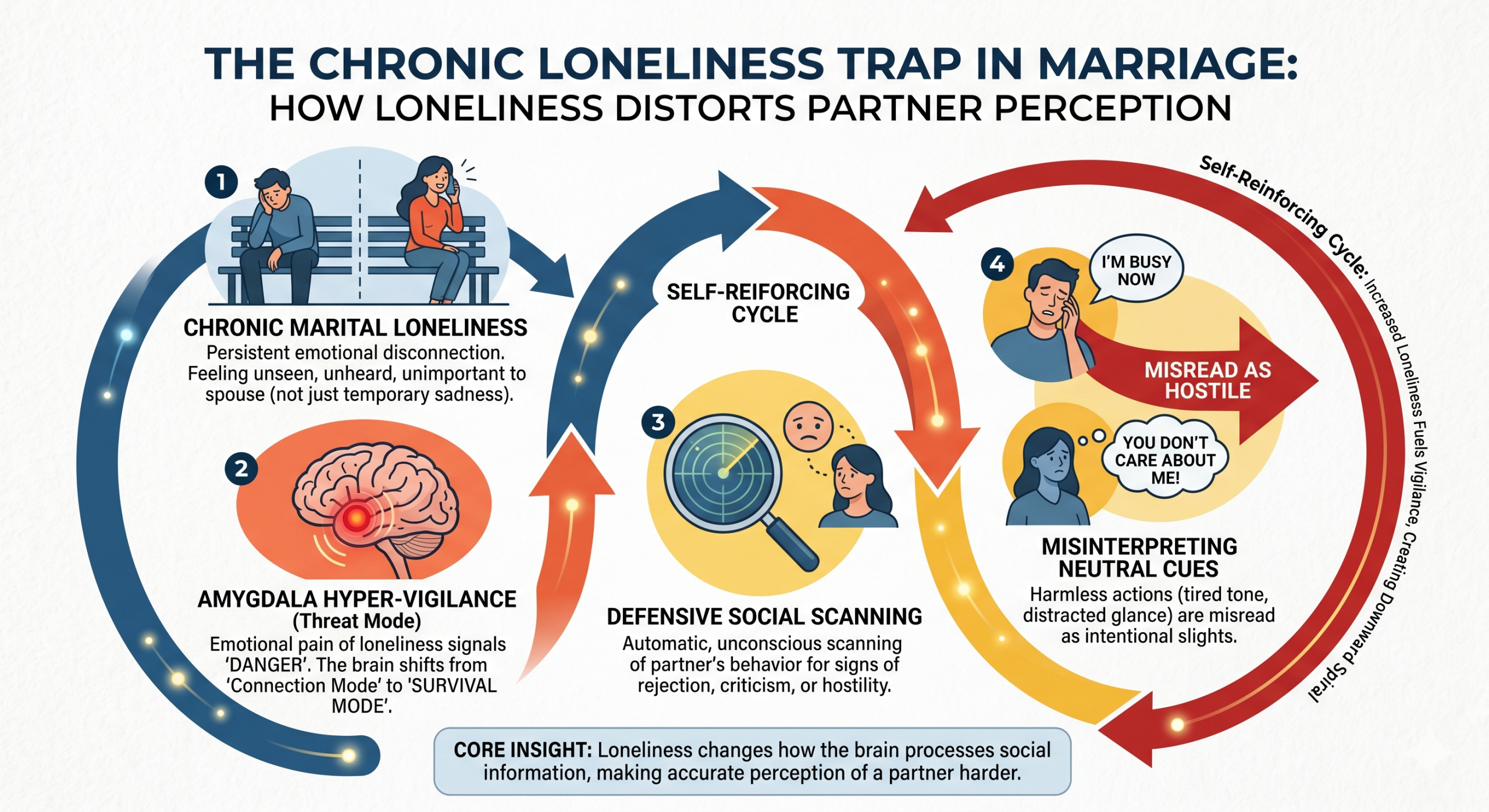
When loneliness creeps into a marriage, it messes up your brain chemistry. You might start doing what psychologists call defensive social scanning, where you misread your partner’s neutral actions as signs of hostility or apathy. This creates a vicious cycle of isolation, but knowing the science behind it can help you break free.
The Science of the “Lonely Brain”
To understand why a bad marriage feels so stifling, we need to look at how our brains are wired. Humans are social creatures; for our ancestors, being alone could mean danger. So when you feel chronically lonely, your brain sees it as a real threat.
Feeling emotionally unsupported by your partner kicks your brain’s threat detector, called the amygdala, into high gear. This part usually stays calm in a good relationship, but in a lonely marriage, it goes into hyper-vigilance, always on the lookout for signs of rejection.
This constant state of alertness takes a toll on your brain. When you’re busy trying to protect yourself from emotional risks, it drains energy from the part of your brain that deals with logic, emotions, and decision-making. Long-term studies of couples show that this mental fatigue leads to faster burnout and worse physical health. Your body feels the impact of your brain’s hyper-vigilance, resulting in inflammation and increased stress hormones.
In everyday life, this shift changes how you perceive reality. If your partner sighs while doing the dishes, your anxious mind might think, “They’re upset with me and regret being married,” when really, they might just be tired from a long day. If a text goes unanswered for two hours, your amygdala screams, “I’m being ignored because I don’t matter,” when in reality, their phone might just be out of reach.
The Loneliness Trap: How We Accidentally Self-Isolate
The unfortunate truth about a lonely brain is that its protective strategies often lead to the very rejection it fears. This results in two main behaviors that can quietly erode marital intimacy.
Defensive Social Scanning
When you expect rejection, you start hunting for evidence. You overlook the small kindnesses your partner shows and focus solely on their moments of distraction or coldness. If they compliment you, you might think they’re being manipulative. If they’re quiet, you assume they’re mad. You end up viewing your marriage through a lens of fear.
Reflexive Hyper-Independence
To avoid the pain of reaching out and getting shut down, you build up a wall. You stop asking your partner for emotional support or help with daily tasks, thinking, “I’ll just handle this myself; it’s simpler.” You might label this withdrawal as “keeping the peace” or “being strong,” but it’s really just a way of quietly checking out of the relationship.
When you retreat into this hyper-independence, your partner doesn’t see your struggle—they just see you pulling away.
This painful cycle of marital loneliness looks like this: You withdraw to shield yourself from rejection. Your partner misreads your distance as a sign of disinterest or lack of love. Their amygdala goes on high alert, and they start to pull back too. Now both of you are stuck in your own protective bubbles, feeling lonely but thinking the other person is to blame.
The CALM Strategy: Shifting from Threat to Curiosity
Breaking this deeply ingrained neurological cycle requires a conscious shift from a defensive, protective mindset to one focused on intentional self-reflection. When your amygdala screams that you are under attack, you cannot simply “think positive.” You have to actively down-regulate your nervous system.
By using the C-A-L-M Framework, you can systematically reduce your brain’s threat response, quiet the defensive radar, and begin viewing your relationship through a lens of objective reality rather than fear.
C – Confront the Reality (Mindfulness)
The moment your partner does or says something that hits a raw nerve, your automatic instinct is to react to the threat. To break the loop, you must learn to interrupt the automatic processing.
The Practice: Pause and take a slow, deep breath. Ask yourself: “Am I reacting to what they actually said, or am I reacting to the story my mind is spinning about what they meant?”
The Goal: Create a micro-second of space between their behavior and your reaction. Your job here is simply to separate objective data (their words) from emotional interpretation (your brain’s defensive filter).
A – Assess the Toll (Lifelong Learning)
When the lonely brain is in survival mode, it defaults to a single, hostile conclusion to protect itself. To override this cognitive bias, you need to treat communication as a skill that requires active retraining.
The Practice: Implement the “Three Alternatives” Rule. The moment your mind jumps to a painful conclusion (e.g., “They didn’t answer my text because I don’t matter”), force yourself to generate three non-hostile, realistic explanations.
The Examples:
They are deeply preoccupied or overwhelmed by a work deadline.
Their phone is on silent in another room.
They read it, got distracted by an immediate task, and fully intend to reply later.
L – Locate Your Power (Nervous System Regulation)
You cannot access logic while your amygdala is actively flooding your body with stress hormones. Before you try to speak, communicate, or resolve an issue, you must signal safety to your body.
The Practice: Utilize physiological down-regulation. This can look like a “physiological sigh” (two quick inhales through the nose, followed by one long, extended exhale through the mouth), splashing cold water on your face, or physically changing your environment by stepping outside for a moment.
The Goal: Safely lower your heart rate and reduce cortisol levels. By shifting your body out of “fight-or-flight” and back into connection mode, you clear the mental fog caused by relationship burnout.
M – Manage Your Next Move (Self-Reliance)
Marital loneliness becomes dangerous when we place the entire burden of our emotional well-being onto a distant or emotionally unavailable partner. Reclaiming your personal autonomy is not about punishing your spouse by withdrawing; it is about protecting your own mental health.
The Practice: Shift some of your focus inward. Intentionally invest time into nurturing your own friendships, exploring personal passions, establishing a fulfilling routine, and building an inner life that belongs solely to you.
The Core Insight: Strengthening your independence reduces your brain’s frantic, desperate need for immediate validation from your partner. Ironically, when you calm your nervous system and stop constantly demanding approval, you lower the baseline tension in the home—making you far more approachable and opening the door for genuine reconnection.
Do you want to put this framework into action? Click here to download our printable C-A-L-M Framework Worksheet to track your progress this week
Marital loneliness is a complicated issue, but it’s not something you’re stuck with forever. By realizing when your mind is misleading you to “protect” you, you can find the strength to lower your defenses and change the dynamic.